
Editor’s Note (12/30/24): Former President Jimmy Carter died on December 29, 2024, at the age of 100.
Former U.S. president Jimmy Carter entered hospice care at his Plains, Ga., home last month. Much has been written about his legacy of stamping out Guinea worm disease, creating affordable housing through Habitat for Humanity and inspiring cancer patients with his own successful fight against metastatic melanoma. Carter may also be the politician who, more than any other, changed the country’s energy future. Under his four years of American leadership, landmark events and legislation opened up a new world of “alternative energy” as a way to wean the country from its troublesome reliance on fossil fuels. Here are seven highlights from the beginning to end of his term.
Wear a Sweater
On supporting science journalism
If you're enjoying this article, consider supporting our award-winning journalism by subscribing. By purchasing a subscription you are helping to ensure the future of impactful stories about the discoveries and ideas shaping our world today.
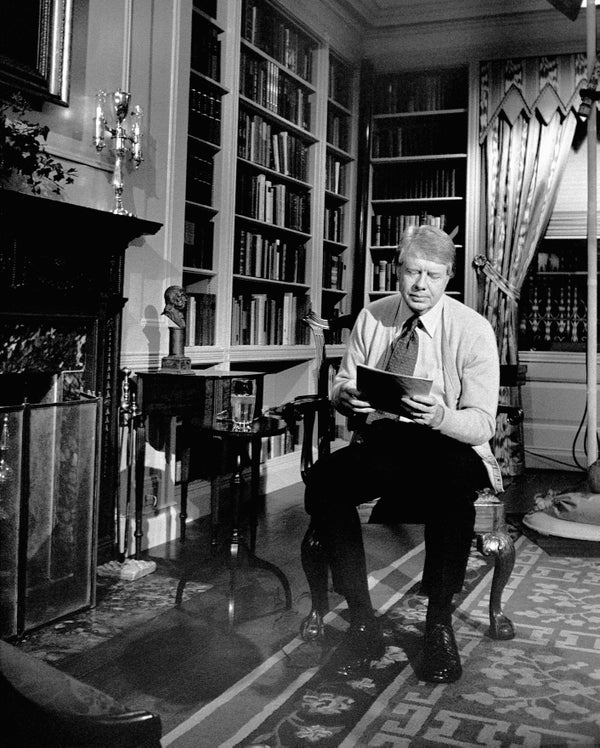
The 1973 oil embargo shocked the world. Countries belonging to the Organization of Petroleum Exporting Countries cut exports to the U.S. as retribution for supporting Israel in the 1973 Arab-Israeli War, causing prices to rise steeply. On February 2, 1977, Carter addressed the nation on television while sitting next to a roaring fire in the White House Library, wearing a sweater. He encouraged Americans to help lessen the country’s dependence on foreign oil by taking steps to reduce energy usage, including turning down their home thermostat.
Moral Equivalent of War
On April 18, 1977, Carter addressed the nation again, saying it had to stridently reduce dependence on overseas oil with a fervent, unified effort that was the “moral equivalent of war.”
U.S. Department of Energy
The 1970s oil crisis also showed how disjointed the federal government’s handling of energy was. Carter and Congress together took steps to create the DOE, which he signed into law on August 4, 1977, to oversee national energy policy and to consolidate the various agencies involved.
Strategic Petroleum Reserve
To create a buffer against future embargoes or supply interruption, in 1975 the U.S. established the Strategic Petroleum Reserve (SPR). The government would buy oil on the market and store it. Under Carter, underground salt domes in Louisiana and Texas were selected as the storage sites in April 1977, and he began to fill the reserve in July 1977. Today the SPR’s maximum capacity is 714 million barrels. Various presidents have occasionally tapped it to try to bring down high retail gasoline prices by adding supply to the market. They include George H. W. Bush, who utilized the SPR during Operation Desert Storm in 1991, and George W. Bush, who did so after Hurricane Katrina in 2005. In 2022 Joe Biden released oil from the reserve when low global production and supply chain interruptions kept prices well above $4 a gallon.
National Energy Act of 1978
This one piece of legislation jump-started a number of initiatives that were rooted in the idea of conserving energy. Before then, energy was largely seen as cheap and unlimited. The act had provisions to reduce energy demand, to promote greater use of domestic energy sources—especially renewable sources—through taxes and tax credits and to raise fuel efficiency.
Solar Panels
In the summer of 1979 Carter had 32 solar panels installed on the White House roof to reflect his belief in “clean,” renewable energy sources. The panels heated water for household use. They remained in place until 1986, when then president Ronald Reagan had them removed.
Energy Security Act of 1980
This package had several bills that all boosted what had previously been widely viewed as fringe energy sources. These bills increased support for synthetic fuels, as well as biomass, solar, geothermal and ocean energy. They again emphasized conservation through greater efficiency.